
What I Wish Someone Had Told Me Before I Got My Real Estate License
Jul 23, 2026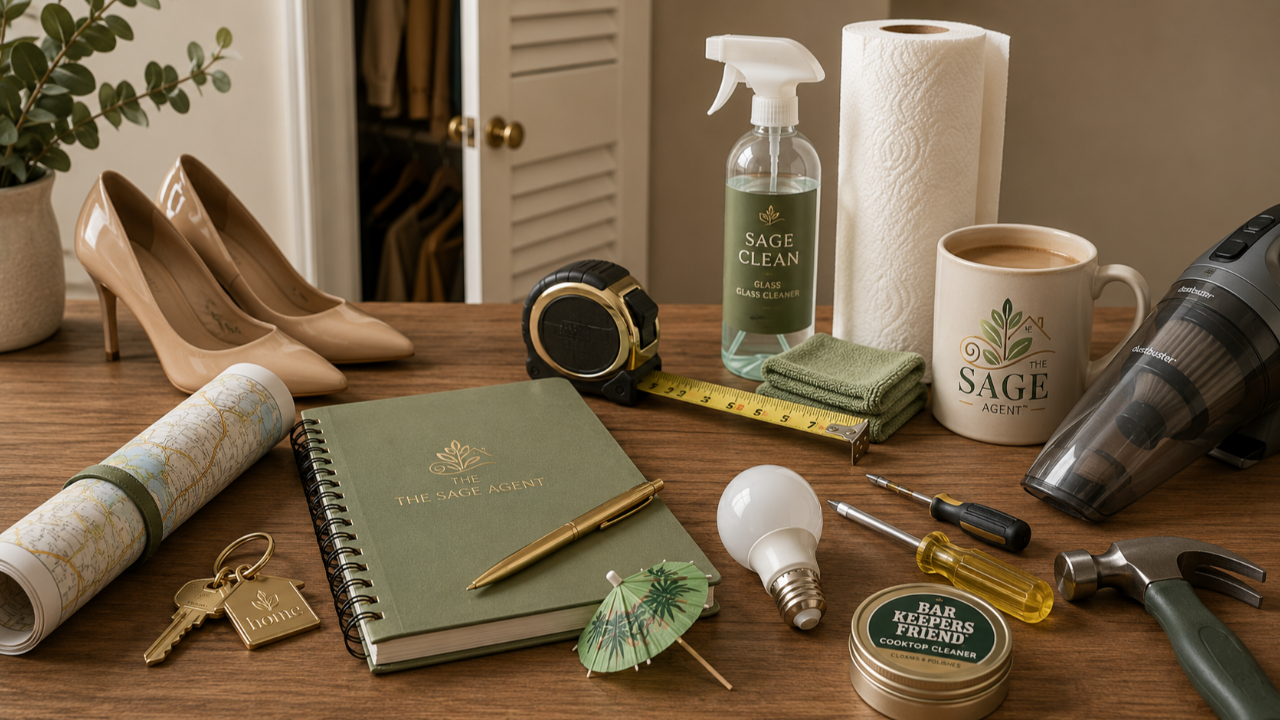
Real estate school can teach you contracts, agency, and property law, but some of the most important lessons come after you get your license. From expensive mistakes and questionable decorating choices to practical lessons I never saw coming, here are a few things I learned the only way you really can: by doing the job.
There are a lot of things you learn in real estate school.
You learn about contracts and agency relationships. You learn about fair housing and property rights. You learn enough real estate math to make you briefly reconsider whether you really need a new career after all. And eventually, if all goes according to plan, you pass the test and someone hands you a real estate license.
Congratulations!
You now know approximately 12% of what you need to know.
Okay, I made that number up. But some days, 12% feels generous.
When I got my real estate license at 57, I was excited, ambitious, and ready to roll up my sleeves and get to work. What I didn't realize was how much of this business you simply cannot learn from a textbook. You learn it by doing it.
Sometimes you learn it by making a $2,500 mistake. Sometimes you learn it while cleaning someone else's toilet. And sometimes you learn it while standing in the primary bedroom of a lovely elderly couple staring at something on the nightstand that you desperately wish you had not seen.
So, in the interest of preparing the next generation of real estate agents slightly better than I was prepared, here are a few things I wish someone had told me.
Let's begin with the $2,500 lesson.
I was a brand-new agent with my very first listing. When I was filling out the listing paperwork, I carefully went room by room with the seller, noting the specific attributes and function of each room. One of the rooms had a bed in it. It had an armoire. It looked like a bedroom. The sellers were using it as a bedroom.
So I called it a bedroom.
Seems reasonable, doesn't it?
Not so fast.
At the time, the listing requirements in my market stipulated that the room needed a closet for me to represent it as a bedroom. I didn't know that, and the buyers didn't notice the missing closet when they made their offer.
Their inspector did.
The solution was for the buyers to add a closet after closing. The cost was about $2,500.
Guess who paid for it?
That would be the brand-new listing agent who had called a room a bedroom because there was a bed in it.
There are less expensive ways to learn the intricacies of property descriptions. I recommend those.
I learned very quickly never to assume. If you're representing something about a property as fact, know what qualifies it as fact. I have never looked at a closet quite the same way since.
My education continued with my very first showing.
It was a beautiful home owned by a very elderly couple. My buyers and I were touring the house, everything was going nicely, and then we walked into the primary bedroom.
There, prominently displayed on the nightstand, was a rather impressive adult toy.
Real estate school had not covered this.
There had been no chapter titled Maintaining Professional Composure When Confronted With Unexpected Personal Items. No role-playing exercise. No multiple-choice question.
Just me, my buyers, and a moment none of us had anticipated.
I don't remember exactly what I said, which probably means some merciful part of my brain has erased it. I do remember nervous laughter all around, especially when we bumped into the sweet older couple on our way out. But I learned something very early in my career: When you enter people's homes for a living, you are entering their lives.
You will see things.
Your job is to remain professional, keep moving, and occasionally develop a sudden, intense interest in the crown moulding.
I also learned that my personal decorating opinions were best kept to myself.
I was once showing buyers a house with a guest bathroom that can only be described as Key West tiki bar chic. The walls were painted neon green. The shower rod had been decorated to resemble a thatched roof. The shower curtain featured palm trees and monkeys.
It was ... a commitment.
As we walked in, I was preparing to reassure my buyers that paint was easy to change and the tiki hut could presumably be dismantled without heavy machinery.
Fortunately, I kept my mouth shut for about three seconds longer than I otherwise might have.
My buyers squealed. With delight.
They thought it was the most fantastic bathroom they had ever seen.
They wouldn't change a thing.
And that was the day I stopped offering opinions about anyone else's decorating choices.
I wasn't there to decide whether I wanted to live in the house. I was there to help my clients evaluate the things that actually mattered: condition, structure, layout, location, functionality, and value.
If they wanted monkeys on the shower curtain, God bless the monkeys.
Then there was the “Well that was a waste!” money spent.
When you're a new agent, you are extraordinarily vulnerable to the phrase, “Every successful real estate agent needs this.”
I fell for it.
Apps. Tools. Resources. Subscriptions. Systems. Things that promised to organize my leads, automate my marketing, revolutionize my follow-up, transform my productivity, and quite possibly make my coffee in the morning.
I signed up for far too many of them.
I didn't need most of them.
When you're starting out, it's easy to think everyone else knows some secret you don't. If a successful agent is using a particular tool, surely that's what you're missing.
Usually, it isn't.
Start simple. Add tools when you have an actual problem that the tool will solve. In other words, don't create a $99-a-month solution for a problem you don't have yet. Those $29, $49, and $99 monthly subscriptions have a sneaky way of turning into thousands of dollars a year.
I also wish someone had mentioned that real estate is considerably more glamorous on television.
Speaking of rolling up my sleeves to get to work, I have cleaned more toilets as a real estate agent than I ever imagined I would.
You can have professional photographs taken. You can create beautiful marketing materials. You can show million-dollar homes and negotiate contracts worth hundreds of thousands of dollars.
And then, 20 minutes before an open house, you may find yourself holding a roll of paper towels and wondering how on earth the powder room got into its current condition.
Homes are messy. People are messy. Things happen.
The glamorous part of real estate exists, absolutely. But so does sweeping a kitchen floor, replacing a burned-out light bulb, wiping fingerprints off a glass door, and cleaning a toilet because buyers are arriving in ten minutes and somebody has to do it.
Sometimes that somebody is you. And don’t even get me started about the bat poop.
Eventually, I stopped being surprised by the things I needed and started carrying them with me. My Realtor survival kit came to include a tape measure, tape, paper towels, a toilet brush, toilet cleaner, glass cleaner, ceramic cooktop cleaner, wood cleaner, all-around cleaner, flat-head and Phillips screwdrivers, a hammer, a flashlight, light bulbs, a broom, shoe booties, and a Dustbuster. I'm definitely forgetting something.
Why?
Because eventually you will need every single one of them.
Probably five minutes before someone arrives.
You will discover a dirty cooktop before a showing. A burned-out bulb before photography. Something loose that needs tightening. A floor that inexplicably needs sweeping even though supposedly, no one has been in the house.
Being prepared for the ridiculous little things makes the important things much less stressful.
I also learned fairly quickly that a good pair of heels and acreage are natural enemies.
I love a good pair of heels.
Acreage does not love a good pair of heels.
There is nothing particularly sophisticated about trying to maintain your dignity while your shoe sinks into soft dirt and your clients and their sensible shoes are already halfway across the property.
You may walk gravel driveways, uneven lots, fields, construction sites, muddy yards, steep hills, and terrain that apparently has not encountered another human being since the Louisiana Purchase.
Dress professionally. But dress for the property you're showing.
Your ankles will thank you.
Technology provides its own lessons.
Navigation systems are wonderful until they aren't. Cell service disappears. Batteries die. Roads don't show up correctly. GPS occasionally develops a creative interpretation of the phrase “You have arrived.”
Keep a map in your car.
Yes, an actual paper map.
It may feel delightfully 1997 until the day you're driving around an unfamiliar rural area with no cell service and clients following you.
Then it feels like genius.
And while we're discussing getting from one house to another, if you're showing homes on a holiday, check the parade routes.
Trust me on this one.
There are few things more humbling than carefully scheduling a series of showings only to discover that you cannot physically get your buyers to one of the houses because half the town is standing between you and it waving tiny American flags.
Some lessons come from real estate school.
Others come from a marching band blocking Main Street.
There was one other lesson that took me a little longer to understand.
Other real estate agents can be wonderful colleagues. I've met terrific agents over the years. I've learned from them, worked alongside them, referred business to them, and developed genuine friendships with them.
But at the end of the day, they're also competing for the same listings, the same buyers, and many of the same opportunities.
That doesn't mean becoming guarded or adversarial. Quite the opposite. Being known as an agent who is professional, cooperative, ethical, and pleasant to work with matters enormously.
But this is still a business.
Be kind. Be generous. Build good relationships with other agents. Help when you can.
But never forget that you are building a business. Your business.
Finally, the biggest thing I wish someone had told me is much simpler:
You're going to learn by doing.
I thought getting my real estate license meant I was supposed to know how to be a real estate agent.
It didn't.
Getting my license meant I had met the requirements to begin learning how to be one.
There's a difference.
The classroom can teach you rules. Your broker can teach you contracts and procedures. Training can give you tips, insight, systems and strategies. But there are things you simply have to experience.
You have to make a mistake and figure out how to fix it. You have to discover which tools you actually need and which ones you bought because somebody had a really persuasive webinar.
You have to learn when to speak and, perhaps more importantly, when not to offer your thoughts on a neon-green tiki bathroom.
You have to get lost once or twice.
You have to clean the toilet.
And little by little, something happens.
The things that once made you nervous become routine. The questions that once sent you scrambling for help become questions you can answer confidently. You stop worrying quite so much about whether you're doing everything right because you've learned what to do when something goes wrong.
That's experience.
And unfortunately, there isn't an app for it.
If you're newly licensed, or thinking about becoming a real estate agent, don't expect yourself to know everything on day one. Learn the fundamentals. Ask questions. Find people you trust. Prepare ridiculously well. Own your mistakes when you make them. When possible, choose to laugh instead of cry. And pay attention to every transaction, because each one will teach you something the last one couldn't.
Years from now, you'll have your own collection of stories.
Hopefully, yours will cost less than $2,500.
And, with any luck, involve fewer surprises on the nightstand.
Believing in what's possible,

Gwen Holloway
Founder, The Sage Agent™
p.s. Ready to learn how to turn decades of life experience into a thriving real estate business? Join the waitlist for The Sage Agent™ Signature Course, created specifically for women 50+ who want to build a relationship-based business that feels authentic, sustainable, and true to who they are.